From dating challenges to standing up to bullies, these friends aren’t afraid to take on the world.
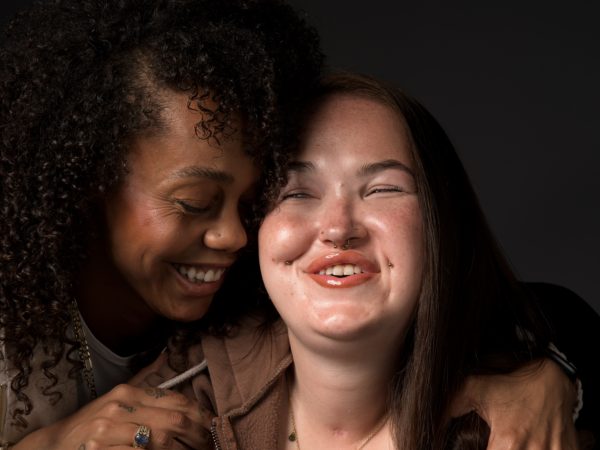
Kat Pemberton and Shanell McLeod are a testament to the power of connection, friendship, and radical self-acceptance.
As part of the Live Pride Wide Open campaign, the pair share their experiences navigating life with disability, defining their own sexuality, and tackling the daily prejudices of a “judgy” world.
Living with Spinal Muscular Atrophy
With Shanell’s support Kat had taken her Louis Vuitton wheelchair all the way from Wakefield to Brighton to be part of the photoshoot for the campaign.
Kat was diagnosed with spinal muscular atrophy (SMA) type two when she was about one year old. She explains that SMA has four different types, with type one being the most severe and type four the least.
Having been a wheelchair user since age six or seven, Kat notes that growing up with SMA was difficult because they “definitely don’t come with an instruction manual”.
The condition has resulted in numerous physical challenges, including skeletal issues like scoliosis and osteoporosis, which required multiple surgeries.
A significant challenge is internal organ communication with the spinal cord. Kat has also had repeated bouts of pneumonia. She shares: “I’m not able to have a cough or a breath intake that’s as effective as a non-disabled person and that can be quite difficult.”
Kat was born in Kryvyi Rih, Ukraine, and moved to England when she was six. Her mother sought better medical care because, where they lived, it “was very rural, very post-Soviet era”.
Kat reflects on the contrast of coming to England, which “was like time travelling because we’ve gone from one extreme to the other”.
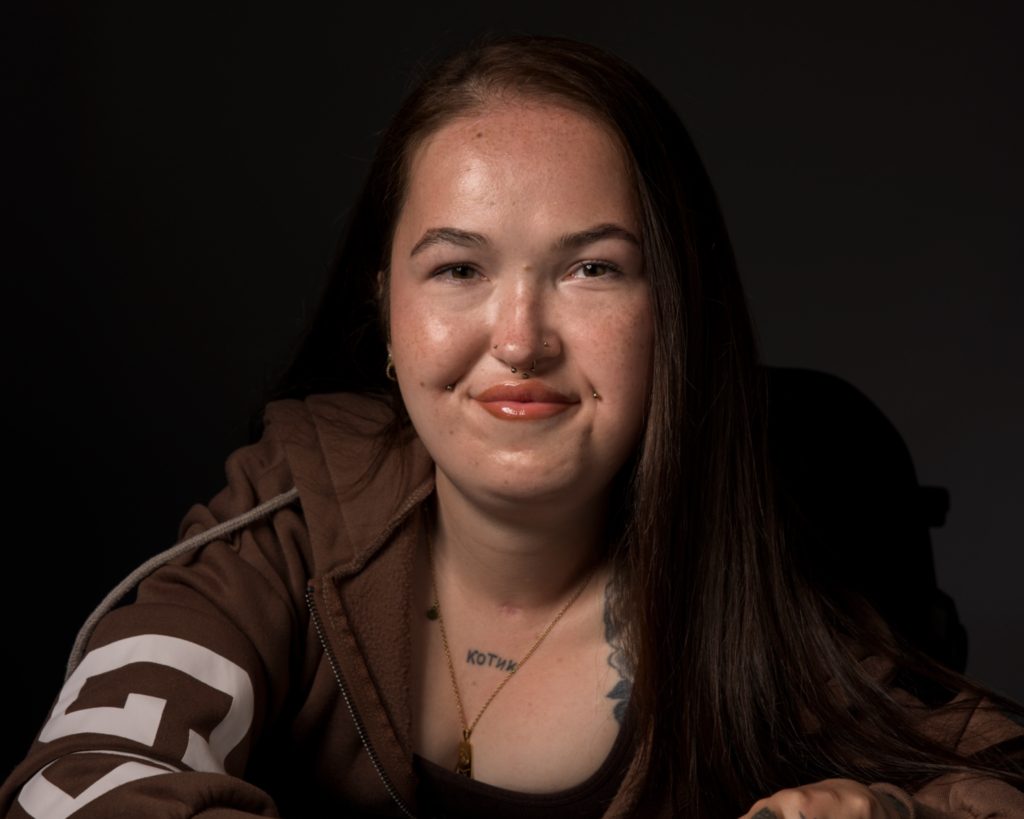
A bond beyond labels
Shanell has been Kat’s carer and close friend for three years – a relationship she describes as transformative.
“It feels longer,” Shanell says. “It feels like we’re meant to be. Like soulmates. It’s crazy how close we are and she’s taught me so much. She’s opened my eyes. She took me to my first Pride.”
While Kat identifies as a lesbian, Shanell prefers to be “label free”.
“I don’t put a label on anything in life. It’s just about connections. Vibes,” Shanell explains.
She credits Kat with expanding her worldview: “I wasn’t small-minded because I’m very open to everything but I was unsure about a lot of things. I wasn’t quite “woke” and Kat has opened me up to lots of things.”
This mutual growth confirms that their connection is a two-way relationship.
Unapologetically you: Identity and disability
Kat’s journey to discovering her sexuality was complicated.
People with disabilities tend to be desexualized by society and being home-tutored for much of her education meant she “wasn’t even around peers, my own age”. As a result, she missed common experiences.
She recalls being 16 when she first thought she liked girls but spent years exploring her feelings.
Coming out was awkward, especially with her Ukrainian family. While her mother was accepting, Kat delayed telling her until she was about 19, and her grandmother still doesn’t know.
Kat notes that having an accepting carer like Shanell makes it easier. She contrasts this with past conversations where people — even those who claimed to care about her — have tried to invalidate her identity, saying: “You don’t really know what you feel until you try and be with a man.”
Kat challenges this notion: “But who are you to tell me what should be the standard or what I am feeling or that it’s wrong?”
This prejudice extends to dating. Kat finds that, as a disabled person, she is “already part of a minority”. She has faced rejection from people who ultimately tell her, “I love you but you’re too disabled”.
Kat says: “I have done an experiment before where, on a dating app, I’ve taken away that I have a wheelchair and I do get a lot more engagement when people can’t see I’m disabled. People are choosing to opt out before they’ve even got to know me.”
Tackling ignorance together
Kat explains that prejudice often manifests in subtle ways, describing daily challenges as “micro, subtle progressions” that “seem barely there. But they are there”. She recalls being at a train station recently when “someone barged in front of me to get through the gate and hit me with their bag and just walked off”.
Shanell admits she struggles to cope with the “lot of ignorance” she witnesses: “Kat’s so used to it. But I’m so protective over her. She can turn a blind eye to a lot of things but I struggle.”
The strength of their friendship is rooted in shared experiences. When asked what they bonded over, Shanell immediately responds: “Trauma.”
She recounts growing up always being the only brown, tallest child, which led to “a lot of bullying and just always being different to everybody else and never feeling like you’re fit in. So now we’re both like ‘F-you!’”
This unapologetic stance reflects the Live Pride Wide Open campaign.
Shanell saw this freedom firsthand at her first Pride in Leeds: “Unbelievable. I love people who are unique… That’s what made Pride for me, seeing that people are just so comfortable, being able to be themselves and nobody’s judging them.”
Kat says her experiences and the Ukraine war have taught her another key message in the spirit of “Open”, namely: “Just to support those around you. You never know when it’s going to be your own family. So why not help those in need?”.
Shanell adds a final message of hope based on personal experience: “I wish when I was younger I’d known that it doesn’t last forever. When you’re young, you feel like everything’s so heavy and it’s never gonna pass. But as you get older we always know at the end it’s gonna be better.”
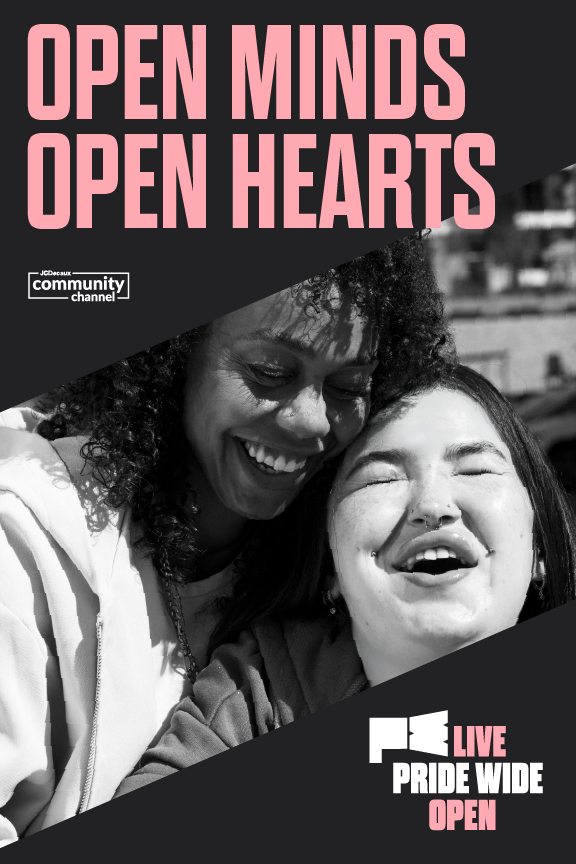
Live Pride Wide Open
You can see the Live Pride Wide Open campaign throughout June 2026 on JCDecaux outdoor screens around the UK and at Outernet in Tottenham Court Road, London. Read the stories behind the images on our Pride Wide Open page. And if you can, please make a donation so we can keep tackling hatred and promoting a world where all LGBTQIA+ people can thrive.